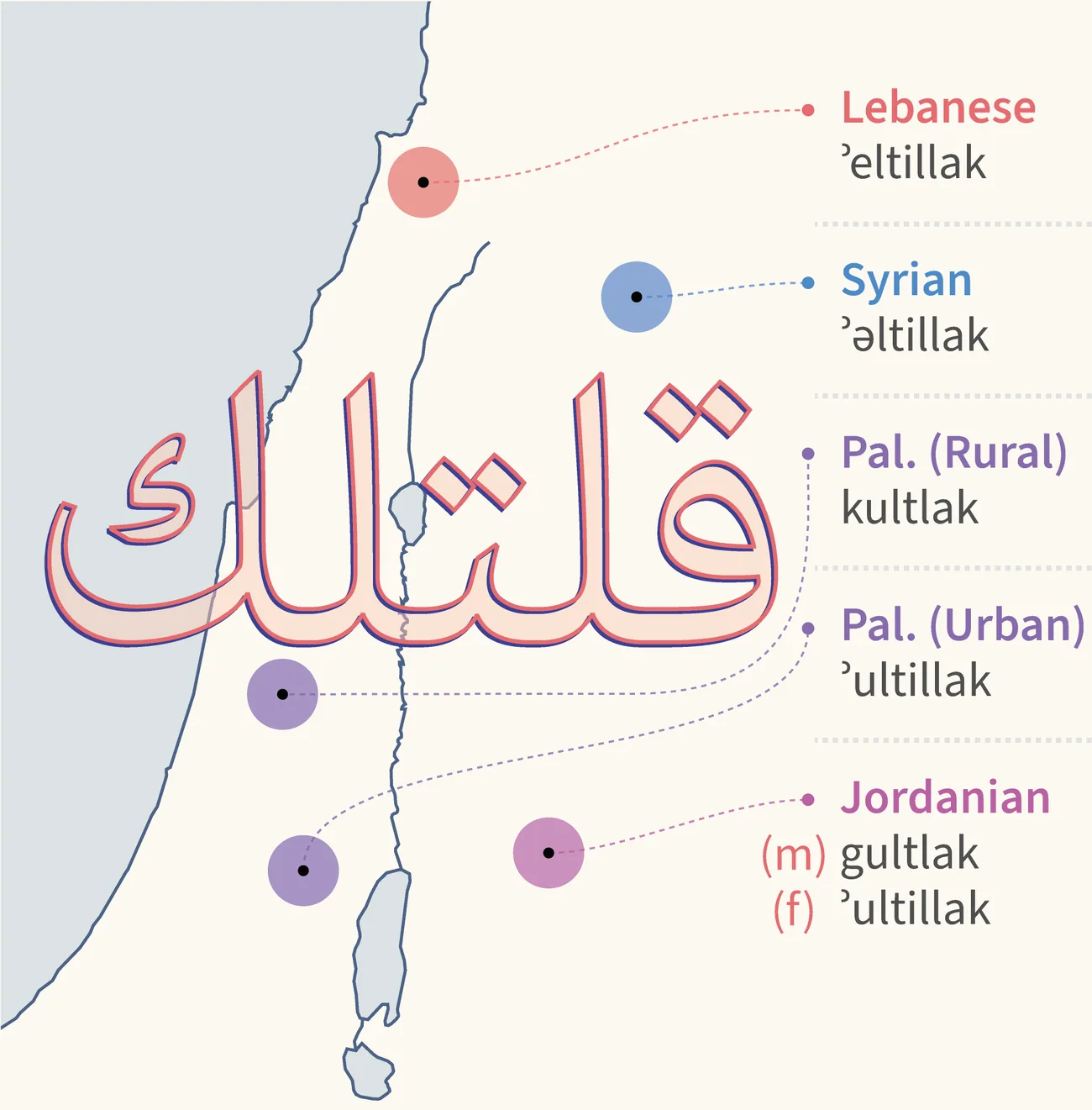
We introduce SHAMS, an evaluation benchmark for Arabic NLP and speech technology that ties diacritization, G2P, ASR, and A2P together over the same utterances, grounded in audio and stratified by LA variety.
Abstract
Levantine Arabic (LA) is spoken by tens of millions of people, creating a pressing need for shared benchmarks to evaluate LA speech-language technologies. Evaluating such technology is particularly challenging given LA’s internal diversity and its opaque and non-standardized orthography.
We present SHAMS (SHami Annotated Multi-dialect Speech), a benchmark comprising 1,300 utterances drawn from open audio corpora, balanced across five LA varieties (Urban and Rural Palestinian, and Urban Jordanian, Lebanese, and Syrian). Each utterance is represented across four aligned tiers: audio, unvocalized orthography, diacritized text, and phonetic transcription. This structure supports evaluation of various downstream tasks such as diacritization, grapheme-to-phoneme conversion, automatic speech recognition, and audio-to-phoneme, grounded in audio and stratified by variety. We benchmark open and proprietary models across these tasks to demonstrate the utility of this benchmark for measuring progress across LA.
Contributions
- A balanced spoken corpus of 1,300 utterances drawn from open audio sources, covering five Levantine varieties
- Multi-tier annotations aligned to each utterance consisting of diacritized Arabic and phonetic transcription, thus enabling joint evaluation of diacritization, G2P, ASR, and A2P.
- Baseline results across open and proprietary models, stratified by variety, demonstrating the benchmark’s utility for distinguishing model performance across tasks and varieties.
Four aligned tiers
Each utterance in SHAMS includes four aligned tiers:
- (i)The audio segment
- (ii)Unvocalized Arabic orthography
- (iii)Fully diacritized Arabic
- (iv)Phonetic transcription
Four tasks
- Diacritizationrestoring vowel and gemination marks
- G2Pmapping orthography to phonetic transcription
- ASRtranscribing audio to text
- A2Ptranscribing audio to phonetic transcription
G2P: grapheme-to-phoneme conversion. ASR: automatic speech recognition. A2P: audio-to-phoneme conversion.
Composition
SHAMS comprises 1,300 utterances totaling roughly 15,500 words and just over two hours of speech, spread across five Levantine varieties. The benchmark is built on the Levantine portions of two open multi-dialectal Arabic speech corpora, Casablanca and LangMedia.
| Variety | Source | Utt. | Words | Min. |
|---|---|---|---|---|
| Pal./Urban | both | 230 | 3,175 | 25.0 |
| Pal./Rural | Casablanca | 234 | 3,153 | 21.8 |
| Jordanian | both | 305 | 3,173 | 25.5 |
| Lebanese | LangMedia | 316 | 3,008 | 29.1 |
| Syrian | LangMedia | 215 | 2,997 | 26.7 |
| Total | 1,300 | 15,506 | 128.2 |
Citation
@misc{sapirstein2026shams,
  title = {{SHAMS}: An Audio-Grounded Pronunciation
           Benchmark for {L}evantine {A}rabic},
  author = {Sapirstein, Ben and Mattar, Roy and
            Mor-Lan, Guy and Mohamed, Ahlam and
            Cerqueglini, Letizia and Alper, Morris},
  year = {2026},
  eprint = {2610.01427},
  archivePrefix = {arXiv},
  primaryClass = {cs.CL},
  url = {https://arxiv.org/abs/2610.01427}
}